

There is a very specific kind of love that Mk6 owners have for their cars. The sixth-generation Golf (Typ 5K, built on the PQ35 platform) was crowned World Car of the Year in 2009, earned five Euro NCAP stars, and around 2.85 million units rolled off the line between 2008 and 2012 — roughly 3.6 million including all derivatives such as the GTI, GTD, Golf R, Variant and Cabriolet. It has hydraulic steering feel that modern cars simply cannot replicate, a body that still feels bank-vault solid, and engines — the 1.4 TSI, the 2.0 TDI common-rail, the legendary GTI EA888 — that mechanics know how to keep alive almost indefinitely.
And then there is the dashboard.
Two analogue dials, a needle, and a small monochrome multi-function display (MFD) squeezed in between. It was state-of-the-art in 2008. In 2026, it is the single part of the car that most obviously betrays its age — and, increasingly, the part that starts to fail.
That gap between “a car I love” and “a dashboard I have outgrown” is exactly why the Volkswagen Golf 6 Cluster Dashboard upgrade category exists. And UGODE’s 10.25-inch full-screen solution has quietly become one of the most complete answers on the market.
The Hidden Problem: Analogue Clusters Don’t Just Look Old — They Break
This is not only a cosmetic conversation. Instrument clusters are electronic control units that live in one of the harshest environments in the car: extreme temperature cycles, constant vibration, and years of continuous electrical load. The failure modes are well documented across the industry:
- Stepper motor failure — the tiny X27.168 motors that drive the needles strip their plastic gears, so the speedo sticks, stutters or drops to zero.
- LCD ribbon degradation — heat cycles lift the adhesive on the flexible display cable, producing missing segments and dead pixel blocks. Notoriously common on VW, Audi and BMW units of this era.
- Backlight and LED burnout — including the “no backlight on the speedo/rev needle” complaint logged by repair specialists specifically for the Golf Mk6.
- Dry solder joints and total blackout — intermittent power loss that eventually becomes permanent.
For a Mk6 owner, the traditional fixes are all bad: pay dealer money for an OEM unit that will fail the same way, buy a used cluster that cannot be coded without VCDS/ODIS and immobiliser work, or ship the dash pod away and lose the car for days. A digital instrument cluster retrofit flips that equation — you are not repairing a 17-year-old display, you are replacing it with new hardware.
Meet the Upgrade: 10.25 Inches, HD IPS, Plug and Play
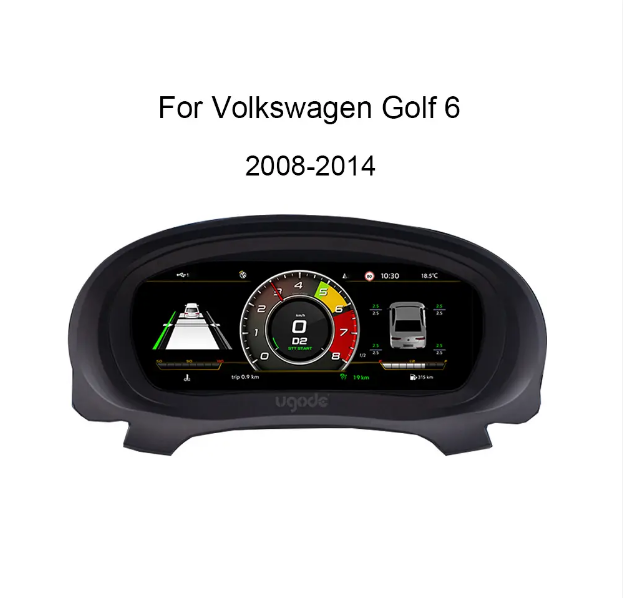
Product: 10.25″ Volkswagen Golf 6 2008-2014 Cluster Dashboard Instrument Full Screen Speedometer
Fits: VW Golf 6 / Golf Mk6 / Golf VI / Typ 5K, 2008–2014 (GTI, GTD, Golf R, GT, Variant, Cabriolet)
Product page: https://www.ugode.com/10-25%e2%80%b3-volkswagen-golf-6-cluster-dashboard-instrument-full-screen-speedometer-product/
At the heart of it is a 10.25-inch HD IPS panel at 1920×720 resolution. That is not an arbitrary number: industry display tracking shows the 10–15 inch range is now the most common size band for in-car displays, accounting for around 60% of the market in 2025, and most digital instrument clusters sit in exactly that band. A 9–11 inch class cluster is also the leading size segment in cluster market research, because it balances information density with driver ergonomics. In other words, 10.25 inches is the sweet spot — large enough for a genuine full-screen layout, small enough to drop into the Mk6 dash opening without cutting the factory structure.
It runs a Linux operating system on a T5 1.5 GHz CPU. That is a deliberate choice. Android-based clusters can look impressive on a spec sheet, but they boot slowly and can lag or hang. A lightweight Linux platform boots fast, runs cool, and is built to be stable for the remaining life of the vehicle — which matters enormously in a safety-relevant component you look at every single drive.
What you keep (this is the part that usually goes wrong)
Cheap aftermarket gauges almost always lose factory data. UGODE’s deep CAN-bus integration keeps it:
- Original mileage / km data
- Tyre pressure (TPMS), oil temperature, water temperature, oil pressure and fuel level
- Cruise control status and door-open indicators
- Real-time fuel consumption data and a car body balance (G-meter) display
- The original instrument cluster buzzer — which must stay installed, or the car will log a combination instrument fault
- Automatic: gear position displays P / R / N / D
- Manual: no gear display by default, and you can configure it yourself
- Petrol, diesel (TDI), and LPG/CNG conversions
- Tachometer reads to 8000 RPM — essential if your GTI or R is tuned
- Ten-language menu: English, German, French, Spanish, Italian, Russian, Japanese, Korean, Arabic and Turkish — a genuine export-market advantage, not a token feature
Fitment that actually covers the whole range
Personalisation
Three driving themes — Classical, Sport and Off-Road — plus the ability to change the on-screen car body colour to match your paintwork, and to show or hide the oil level display. The result is a dashboard that looks like it was optioned from the factory.
Electrical peace of mind
Operating range 9V–16V, working current 0.8A–1.5A, and critically a standby current below 3 mA. That last figure is the one experienced installers check first: a poorly designed cluster that draws tens of milliamps in standby will flatten a Golf’s battery over a long weekend. This one will not.
The Bigger Picture: Why Retrofit Digital Clusters Are Having a Moment
Zoom out, and this product sits squarely in one of the fastest-moving niches in automotive electronics.
The cluster market is digitising fast. Research houses value the global automotive digital instrument cluster market at roughly USD 3.0 billion in 2025, heading toward USD 4.4 billion by 2030 at about 8% CAGR, with Europe the largest regional market; Asia-Pacific leads on volume at about 42% share, with Europe near 28%.
But the real story is retrofit, not OE. Cars already on the road are ageing, and owners are choosing to modernise rather than replace. ACEA puts the average age of EU cars at 12.3 years. Every Golf 6 on the road today is 12 to 18 years old — precisely the age band where analogue clusters fail and owners start comparing their daily driver to a new one.
The money is following. Aftermarket and retrofit channels are growing faster than OE supply, with the aftermarket share of cluster revenue projected to climb from roughly 32% toward 38%. Platform-specific “embedded digital cockpit replacement” kits are the fastest-growing sub-segment in the wider retrofit market, at about 12.4% CAGR and USD 600–1,800 per kit. Unlike head units, where price competition is brutal, clusters carry higher unit value and real technical barriers — distributors typically see gross margins of 25–40%, and a professional install takes one to two hours.
For UGODE’s distributor and installer partners, the VW Golf 6 Cluster Dashboard is a textbook SKU in this category: a huge, well-documented, globally distributed installed base; a platform with known, recurring factory faults; and a solution that removes the two things that normally kill the sale — coding and wire cutting.
Who Is Actually Buying This? Real-World Use Cases
1. The daily driver with a dying dash. The largest group. The MFD pixels are going, a needle sticks on cold mornings, or the unit has gone dark. They were going to spend money anyway; this is the same money spent on something better.
2. The GTI / Golf R enthusiast. They want the 8000 RPM tach, the Sport theme, and a full-screen layout that matches the way the car is actually driven. This is the community that sustains forum discussion around Mk6 retrofits and that drives word-of-mouth.
3. The interior-moderniser. These owners have already fitted an Android head unit with CarPlay. The analogue cluster is now the last thing dating the cabin — and the 10.25-inch panel completes the job.
4. The used-car seller and the small dealer. A Golf with a full-screen digital cluster photographs better, shows better, and differentiates instantly in a crowded classifieds listing.
5. Export markets and fleets. The ten-language menu matters here: Russian and Turkish for Eastern Europe and Anatolia, Arabic for the Gulf, Japanese and Korean for Asia-Pacific — plus taxi and driving-school fleets running high-mileage Mk6 TDIs.
Installation: Genuinely Plug and Play, With Four Things to Get Right
No wire cutting, no coding, no VCDS, no OBD11, no dealer visit. The harness connects to the factory plugs, and the original cluster can be kept intact for a fully reversible install. Two USB leads (upgrade and projection) route neatly into the storage box at the lower left of the steering wheel.
Four practical notes, straight from the fitting instructions, will save you a comeback:
- Before removing the factory cluster, set the winter tyre warning and speed warning to maximum, then switch both functions off in the multifunction speed-limit menu.
- Do not remove the original cluster buzzer — the car will report a combination instrument fault.
- Some higher-spec mechanical clusters have a small PCB board behind the small screen. It must be transferred into the new LCD assembly, or fuel level will read inaccurately and the cluster will log a fault.
- Leave “Physical Light” switched off in the PQ-platform settings; enabling it causes the turn-signal indication to disappear.
If the fuel scale does not read full after a fill-up, run a few hundred metres, then enter Settings → Configuration Calibration → Fuel Tank Volume and enter the remaining refillable volume shown in the driving data. If the on-screen car model image is wrong, use Settings → Vehicle Model Selection, then switch off and lock the car for a few minutes.
Standard practice applies: discharge body static before handling the PCB, hold boards by their edges, and bench-test before final reassembly.
FAQ: Volkswagen Golf 6 Cluster Dashboard
Q1. Will this fit my Golf 6?
It is designed for Volkswagen Golf 6 / Mk6 / Golf VI (Typ 5K), 2008–2014, across GTI, GTD, Golf R, GT, Variant and Cabriolet. Always compare your original mechanical cluster’s outer frame and connector configuration with the fitting route before ordering — that is the single most important compatibility check.
Q2. Does it work with a manual gearbox?
Yes, for both. Automatic cars display P / R / N / D; manual cars show no gear position by default and the setting can be configured by the user.
Q3. Petrol or diesel?
Both. The unit is compatible with petrol, diesel (TDI) and converted LPG/CNG vehicles.
Q4. Do I lose any factory functions?
No. Mileage/km, TPMS, oil temperature, water temperature, oil pressure, fuel level, cruise control status and door-open warnings are all retained through CAN-bus integration. The original cluster buzzer must remain installed.
Q5. Is coding required?
No. There is no VCDS/ODIS coding, no immobiliser marriage, and no cutting or splicing of the factory wiring harness. That is the whole point of the plug-and-play design.
Q6. Will it drain my battery?
No. Standby current is below 3 mA, which is safe for a car that sits for extended periods. Operating current is 0.8A–1.5A within a 9V–16V range.
Q7. What languages does the menu support?
English, German, French, Spanish, Italian, Russian, Japanese, Korean, Arabic and Turkish, among others.
Q8. Can I change the look?
Yes. Three driving modes — Classical, Sport and Off-Road — plus adjustable on-screen car colour and a show/hide toggle for the oil level display. The tachometer reads to 8000 RPM.
Q9. How long does installation take?
A professional installer typically completes the retrofit in one to two hours. DIY is realistic for anyone comfortable with trim removal, provided the four precautions above are followed.
Q10. Is a digital cluster upgrade worth it on a car this age?
For most Mk6 owners, yes — and the economics are getting better, not worse. Factory clusters of this generation fail in predictable ways, replacement OEM units are expensive and scarce, and the car itself has many service years left. You are not just adding a screen; you are removing a known failure point.
Post time: Nov-04-2026