

The 7 Series That Invented iDrive — and Got Stuck There
There is a particular kind of frustration reserved for owners of the BMW E65 and E66.
This is the car that introduced the world to iDrive. The fourth-generation 7 Series (2003–2008) was BMW’s bold statement about the future of in-car computing — a central controller, a dashboard screen, menus instead of buttons. In 2003, that was genuinely futuristic.
Two decades later, it is a museum piece.
The factory screen — 6.5 inches, or on later cars a wide 10.25-inch display — runs on BMW’s CCC system with a 10-pin LVDS connection. It has no touchscreen. No smartphone mirroring. No Spotify, no Waze, no Google Maps with live traffic. The navigation data is roughly two decades stale. Bluetooth, if the car has it at all, handles phone calls and nothing else.
Meanwhile, the rest of the car has aged beautifully. The N62 V8 still pulls like a turbine. The aluminium-intensive chassis still feels a generation ahead. The rear-seat legroom still embarrasses modern sedans. Enthusiasts know that a well-kept E65 is one of the great used-car bargains of the decade — a genuine flagship for a fraction of its original price.
So the car is worth keeping. The screen is not.
That gap between a great car and an obsolete interface is exactly where the BMW E65 E66 Android screen replacement market was born — and it is growing faster than most people realise.
Why Now: The Retrofit Market Has Gone Mainstream
Retrofitting older vehicles with modern infotainment used to be a niche hobby. It is now a substantial global industry.
The numbers make the case. The global aftermarket for infotainment retrofits was valued at roughly $30.9 billion in 2025 and is forecast to reach $57.2 billion by 2034, growing at a compound annual rate of about 7.1% . Across the narrower car-audio head unit market, the aftermarket channel already accounts for around 34.5% of revenue and is growing at roughly 8.4% CAGR — noticeably faster than the OEM channel’s 6.8% .
Three forces are pushing that growth:
1. Cars are getting older, not newer. The average vehicle on the road is now around 11 to 12 years old, and the installed base of pre-2018 vehicles — most without native wireless CarPlay or Android Auto — exceeds 1.2 billion units globally . Those cars are not going away. People are keeping them longer, which means the factory screen has to last longer too.
2. Smartphone projection became non-negotiable. CarPlay penetration reached roughly 71–72% of new vehicles in North America by 2025, with Android Auto close behind . Once drivers get used to having Maps, Messages and Spotify on the dashboard, going back to a car without it feels like a downgrade — even if the car itself is an upgrade. Notably, surveys suggest about 67% of aftermarket head unit buyers now prioritise wireless connectivity over native navigation quality, a complete reversal from a decade ago when the built-in nav chipset was the headline spec .
3. The “no-cut, no-code” path matured. The single biggest historical barrier to retrofit was installation risk — cutting factory harnesses, losing the original system, voiding warranties, or ending up with a car that throws error codes. Purpose-built, platform-specific harnesses have changed that. Industry data from China’s aftermarket shows that “original-screen lossless upgrade” solutions — no wire cutting, no damage to the factory warranty — reached over a third of the retrofit market in the first half of 2026, roughly double their 2024 share .
This third point matters most for an E65. This is not a car you want to experiment on. The electrical architecture is complex, the fibre-optic audio bus is unforgiving, and a botched installation can cascade into problems far beyond the radio.
What UGODE Built for the E65/E66
UGODE’s approach is deliberately conservative in the best sense: replace the screen, keep everything else.
Genuine plug-and-play
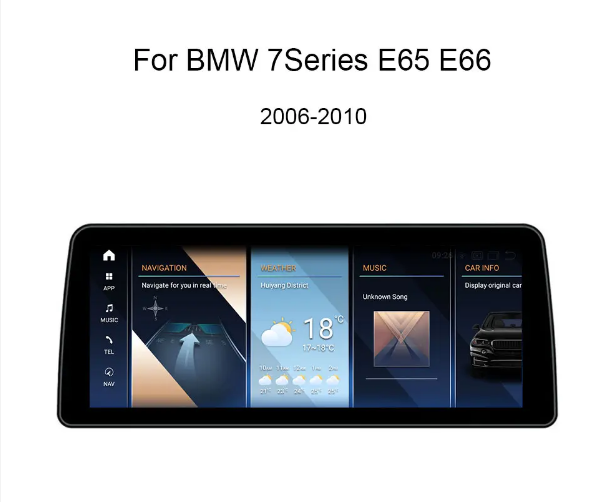
The unit is engineered specifically for the BMW E65 / E66 (2003–2008) CCC system with 10-pin LVDS, replacing the original 6.5-inch or 10.25-inch screen. There is no reprogramming, no coding, and no cable cutting. If you can remove trim panels and turn a screwdriver, this is an afternoon job — and if you would rather not, any competent car audio shop can do it in an hour or two.
Both left-hand drive and right-hand drive cars are supported, which is not a given in this segment — many retrofit screens are LHD-only.
Two display formats
|
|
10.25inch |
12.3inch |
|
Panel |
IPS LCD, G+G touch |
IPS, G+G touch |
|
Resolution |
1280×480 / 1920×720 |
1920×720 |
|
Best for |
Factory-look restraint |
Maximum screen real estate |
Both fit the same dashboard aperture. The 10.25-inch is the subtle choice — it fills the opening without shouting. The 12.3-inch turns the centre stack into something that would not look out of place in a 2026 sedan.
An anti-glare blue-ray screen option is available, which is worth serious consideration on a 7 Series: that windscreen is large and raked, and a glossy panel in direct sun is a genuine usability problem.
Hardware that is actually current
Far too many retrofit screens ship with three-year-old mobile silicon and 2GB of RAM, then stutter the moment you run navigation and music simultaneously. This one does not.
|
|
Specification |
|
CPU |
Qualcomm Snapdragon 680 (SM6225), 6nm LPP, Octa-core — Kryo Gold 2.4GHz + Kryo Silver 1.9GHz |
|
GPU |
Adreno 610 @ 950MHz |
|
OS |
Android 13 |
|
Memory |
4+64GB / 8+128GB / 8+256GB (UFS 2.2 + LPDDR4X) |
|
Display |
10.25″ IPS (1280×480 / 1920×720) or 12.3″ IPS (1920×720), G+G touch |
|
Bluetooth |
5.1 + BR/EDR + BLE |
|
Wi-Fi |
Dual-band WiFi 6, 2.4G b/g/n + 5G a/g/n/ac |
|
4G |
LTE Cat 4 — 150Mbps down / 75Mbps up (SIM card) |
|
Video |
4K playback, H.264 (AVC) and H.265 (HEVC) |
|
Graphics |
OpenGL ES 3.1+, OpenCL 2.0 |
|
CarPlay / Android Auto |
Wireless and wired CarPlay, Android Auto, Phone Link, phone mirroring |
|
Camera |
AHD CCD reverse camera support |
|
GPS |
GPS + BeiDou + GLONASS, online and offline maps |
|
Storage expansion |
Micro TF card + USB, up to 128GB |
|
Operating temperature |
−30°C to +80°C |
The 6nm Snapdragon 680 and UFS 2.2 storage are the specs to look at. That combination is what keeps the interface responsive after two years of app installs, rather than degrading into the sluggish Android-box experience that gives this product category a bad name.
What You Keep — The Part Most Competitors Get Wrong
Here is where a cheap universal Android screen falls apart on a 7 Series. The E65 was not designed with an aftermarket radio in mind. It runs a fibre-optic audio network, integrates climate and vehicle settings into the display, and expects the iDrive controller to be the primary input device. Strip that out badly and you lose far more than you gain.
UGODE’s unit retains the original system entirely:
Factory radio, GPS navigation, Bluetooth, DVD/CD, USB and SD all continue to work
iDrive knob control — the controller you already have still works, which is arguably safer than touch-only while driving
Steering wheel controls — no reprogramming required
Original sound system and fibre-optic (MOST) audio, with lossless audio playback
Factory reverse camera with reverse trajectory lines preserved
360° camera, door-open warning and other vehicle functions where fitted
Switching between the Android side and the original BMW system is a single tap. You are not choosing between modern convenience and the car’s native functionality — you have both, and you can move between them as the situation demands.
That dual-system design is a real advantage over Android boxes that merely overlay video. It is also the reason this is described as a screen replacement rather than a head unit swap.
Split Screen: The Feature You’ll Use Every Day
Android 13 on a 1920×720 widescreen panel makes split-screen genuinely practical rather than a gimmick.
The classic setup: Google Maps or Waze on the main window, Spotify or a podcast on the other. Or navigation on one side and a music player or trip information on the other. Picture-in-picture is supported as well.
Combined with the wired/wireless CarPlay and Android Auto support, you get two complete operating philosophies in one unit — run Android apps natively when you want the full experience, or hand over to CarPlay or Android Auto when you just want your phone’s interface mirrored on a bigger screen.
The built-in 4G SIM slot means the unit does not depend on your phone’s hotspot for live traffic, streaming or online maps — useful on long trips and useful if you would rather not drain your phone battery on every drive.
Interface languages cover English, Chinese, German, Spanish, Korean, Italian, Dutch, Russian, French, Portuguese, Japanese, Hebrew, Thai and Greek, which reflects a genuinely international customer base rather than a single-market product.
How the Wider Market Is Moving
If you are weighing whether to invest in an E65 today, the direction of travel is clear.
Screens keep growing. Industry tracking shows 9-inch to 13-inch displays steadily taking share from traditional 2-DIN formats, with buyers treating a large screen as a baseline expectation rather than a luxury . A 10.25 or 12.3-inch panel in an E65 is not oversized by 2026 standards — it is simply current.
Wireless became the default. Wireless smartphone projection is growing roughly two percentage points faster than the segment average, and manufacturers now reserve wired-only connectivity for entry-level SKUs . Both wireless and wired are supported here.
Android is the retrofit default OS. Android-based units now account for well over half of new aftermarket installations, and hardware is converging around mainstream mobile platforms — Snapdragon 600-series silicon, 4–8GB RAM — which is precisely the configuration in this unit .
Touchscreen infotainment leads the retrofit category by product type, and the “embedded digital cockpit replacement” segment — complete centre-stack modernisation rather than partial fixes — is the fastest-growing slice, with typical kit pricing between $600 and$1,800 . For a flagship sedan, that framing is the right one: this is a cockpit modernisation, not a radio swap.
Social proof is doing the marketing. DIY installation content on YouTube and TikTok has pushed self-installation from roughly 8% of aftermarket purchases a decade ago to around 23% today . Most E65 owners who buy this screen fit it themselves over a weekend.
Is This the Right Upgrade for Your Car?
If
- You have a 2003–2008 BMW 7 Series (E65 saloon or E66 long-wheelbase) with the CCC system and 10-pin LVDS connector
- You want CarPlay or Android Auto without losing iDrive, the factory amplifier or the original camera
- You plan to keep the car and want the interior to feel current
- You would rather not cut a single factory wire
Check before ordering:
- Confirm your connector. This unit is built for 10-pin LVDS CCC cars. If your car has already been modified, or if you are unsure, send a photo of the connector and the current screen to the supplier before purchase.
- Confirm LHD or RHD — both are supported, but specify when ordering.
- Decide on screen size and whether you want the anti-glare panel.
- Decide on 360 camera support — available as a built-in option if your car has or will have a surround-view system.
The Bottom Line
The E65 and E66 were ahead of their time in 2003. There is no reason the driving experience should feel behind the times in 2026.
A BMW E65 E66 Android screen replacement is one of the highest-impact upgrades available for these cars. It costs a small fraction of what the difference between a 2007 and a 2017 7 Series costs, and unlike most modifications, it genuinely improves the car every single time you drive it — navigation that works, music that streams, calls that route through a proper interface, and a factory system that stays exactly as BMW designed it.
You are not replacing the car’s character. You are removing the one part that stopped keeping up.
Post time: Sep-11-2026