

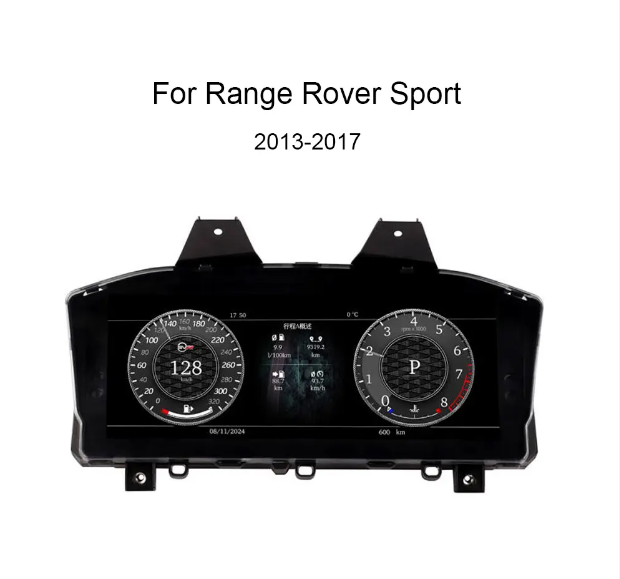
12.3-inch HD IPS, 1920×720, Linux, plug-and-play — a full-screen digital cockpit for Range Rover Sport 2013–2017 that keeps every original vehicle signal.
The Range Rover Sport has always paired serious off-road capability with a lounge-like cabin. In 2013–2017 cars, though, the part that betrays its age sits directly in front of the driver: analogue dials and a small monochrome message centre that look a decade old beside any 2026 dashboard. A Range Rover Sport Instrument cluster replacement once meant a dealer-only retrofit with wiring harnesses, diagnostic programming and a matching bill. Today it means one plug-and-play unit, an hour or two of labour, and a reversible upgrade. Below: what L494 owners actually have, how common digital clusters have become, where the market is heading, and why Ugode’s 12.3-inch full-screen cluster fits the moment.
What is actually in front of L494 drivers today
Most 2013–2017 Range Rover Sport (L494) cars shipped with analogue dials plus a central driver information display. JLR later developed a 12.3-inch TFT Interactive Driver Display for the L405, L494, Discovery, Defender, Velar and F-Pace, with configurable dial, full-map and media themes — but on a 2017 European-market Sport S the full-size TFT panel was still an option, not standard . Retrofitting the genuine unit is a workshop job: cluster, vehicle-specific wiring adapter, trim bezel, VIN verification and programming with a JLR diagnostic tool . That leaves a large parc of L494s with no realistic factory upgrade path — exactly the gap a Range Rover Sport Instrument cluster replacement fills, by reading the same CAN-bus data and presenting it on a modern panel.
Is the digital cluster common? A three-layer answer
New cars: yes. Counterpoint reported at Display Week 2025 that digital clusters appear in around 80 percent of vehicles, with roughly 2.5 displays per car . Chinese smart-cockpit data puts LCD instrument penetration near its ceiling, with growth now driven by size and resolution rather than first-time fitment ; a narrower 2025 estimate counts 12.3-inch-and-larger full-LCD panels at 67.8 percent of new cars .
The 2013–2017 Sport parc: no. It predates the digital-cockpit era, and the OEM retrofit is coding-dependent and costly . Owners comparing their daily driver with a newer Velar or Defender notice the difference immediately.
The aftermarket: fast-growing, still early. Retrofit kits have grown over 22 percent annually since 2020, and more than 15 percent of owners in some enthusiast communities — the BMW F30 is the usual example — have fitted an aftermarket LCD cluster . Analysts see aftermarket share of cluster revenue rising from about 32 toward 38 percent, with platform-specific cockpit replacement kits at roughly 12.4 percent CAGR and USD 600–1,800 per kit . The driver is vehicle longevity: ACEA puts the average EU car at 12.3 years, and owners in North America and Europe increasingly modernise rather than replace .
Short version: standard in the showroom, uncommon in this generation, and one of the fastest-growing corners of automotive electronics.
The market behind the shift
Sizing varies because research houses count different things — modules, display systems, or whole cockpit domains. QY Research valued car digital clusters at USD 3.56 billion in 2024, reaching USD 6.17 billion by 2030 (9.6 percent CAGR) ; Citius Research used a broader scope, USD 8.5 billion in 2023 to USD 16.5 billion in 2030 at 9.5 percent ; 360iResearch projected 15.45 percent CAGR to USD 15.77 billion by 2030 . At cockpit level, one 2025 forecast put USD 29 billion in 2024 growing to USD 48 billion by 2030, with the cluster segment at 8.1 percent CAGR . The absolute figures disagree; the direction does not. Omdia’s first-half 2025 data adds the useful nuance: cluster shipments rose 16.8 percent year on year to 43.3 million units while aftermarket centre-stack displays fell 15.9 percent, because new cars already ship with built-in systems . The retrofit opportunity has moved out of the centre console and into the driver’s line of sight.
Five industry trends shaping the category
1. From more screens to a software-defined cockpit. Omdia calls 2025 the start of a recomposition phase, with displays becoming coordinated visualisation nodes rather than standalone modules ; SID reports the same shift from distributed ECUs to cockpit domain controllers . A dedicated Linux OS fits: fast boot, stable over the 5–10 year life expected of automotive displays versus 1–2 years for consumer panels .
2. CAN-bus fidelity is the real moat. Cheap universal gauges lose factory data. Buyers now expect odometer, TPMS, oil and water temperature, oil pressure, fuel, cruise status and door warnings to survive the swap, read live from the bus . Compatibility with diverse vehicle architectures remains the segment’s main technical hurdle — which is why vehicle-specific integration wins.
3. Reversible, no-coding installation is the purchase criterion. Plug-and-play modules that connect without wire cutting are now the standard description of retrofit products , and fully reversible installs let the factory unit go back at any time . Against an OEM route needing diagnostic programming and VIN-matched configuration , the appeal is obvious.
4. Personalisation and localisation are export features. Customisable interfaces are a stated aftermarket growth driver , and younger buyers increasingly expect upgradable, connected dashboards . Configurable themes, paint-matching body colour and a ten-language menu turn one SKU into an exportable product across Europe, the Middle East and East Asia.
5. Hardware discipline separates a cluster from a screen. Clusters are specified for 800–1,000 cd/m² and long service life ; anti-glare IPS stays readable in direct sun . Installers also check standby draw first, because tens of milliamps will flatten a battery over a long weekend .
Meet the Ugode 12.3inch Digital Cluster Dashboard Full Screen
Ugode manufactures and supplies the Ugode 12.3inch Digital Cluster Dashboard Full Screen for Range Rover Sport Instrument cluster replacement: a vehicle-specific 12.3-inch HD IPS panel at 1920×720 on Linux. It is neither a universal gauge pod nor a head unit — it replaces the cluster itself, plugs into the factory harness and reads original data through a built-in 2-way CAN bus. No diagnostic laptop, no coding, no cut wire; the rest of the vehicle electronics stay untouched.
What you keep, and what you gain
Keep: original Miles/KM, tyre pressure, oil and water temperature, oil pressure, fuel level and consumption, car body balance, cruise control status and door-open warnings — read from the car, not re-created by the panel.
Gain: an 8,000 RPM tachometer; P/N/D/R gear display on automatics; no gear display by default, user-configurable, on manuals; oil level show/hide; a changeable on-screen body colour; Classical, Sport and Off-Road themes plus nine switchable modes; and a 0–100 km/h acceleration test. The ten-language menu covers English, Russian, German, French, Spanish, Italian, Korean, Japanese, Arabic and Turkish. Both gasoline and diesel, automatic and manual cars are supported.
Installation and electrical peace of mind
No cutting, no wire modification, no extra coding: the original cluster comes out, the factory connector plugs into the new unit, and language, theme, colour and mode are selected at first power-up. Nothing is spliced, so the swap is reversible — useful for leases, resale, or simply keeping the original part on a shelf. Electrically it is rated 9 V–16 V, 0.8 A–1.5 A working and under 3 mA standby; that last figure is low enough that a car parked at an airport for two weeks still starts . A 12-month warranty applies.
Full specification
Compiled from Ugode’s product page and factory specification sheet. Where the two sheets use different chip notations (Renesas M2 versus T5 / 1.5 GHz), both are retained; “9 modes” and the three named driving themes are likewise listed as supplied.
|
Category |
Item |
Specification |
|
Display |
Screen |
12.3″ HD IPS full-screen LCD |
|
Display |
Resolution |
1920 × 720 |
|
Display |
Multi View |
Supported |
|
Display |
Type (per factory sheet) |
Water temperature gauge (as listed) |
|
Computing |
Operating system |
Linux |
|
Computing |
CPU |
Renesas CPU (product brief: T5, 1.5 GHz) |
|
Computing |
Chip |
Renesas M2 |
|
Computing |
Vehicle bus |
Built-in 2-way CAN bus |
|
Interface |
Mode switch |
9 modes |
|
Interface |
Driving themes |
Classical / Sport / Off-Road |
|
Interface |
Menu languages |
English, Russian, German, French, Spanish, Italian, Korean, Japanese, Arabic, Turkish (10) |
|
Interface |
Personalisation |
On-screen car body colour change; oil level show / hide |
|
Vehicle data |
Retained signals |
Miles/KM, tyre pressure, oil & water temperature, oil pressure, fuel level, fuel consumption, car body balance |
|
Vehicle data |
Gear display |
P/N/D/R (automatic); no gear display, user-configurable (manual) |
|
Vehicle data |
Tachometer |
Up to 8,000 RPM |
|
Vehicle data |
Status indicators |
Cruise control, door-open warning |
|
Vehicle data |
Performance |
0–100 km/h acceleration test |
|
Compatibility |
Fitment |
Range Rover Sport 2013–2017 |
|
Compatibility |
Transmission |
Automatic and manual |
|
Compatibility |
Fuel type |
Gasoline and diesel |
|
Electrical |
Working voltage |
9 V–16 V |
|
Electrical |
Working current |
0.8 A–1.5 A |
|
Electrical |
Standby current |
< 3 mA |
|
Installation |
Method |
Easy plug / plug-and-play; no wire cutting, no modification, no extra coding |
|
Service |
Warranty |
12 months |
Who this is for
The largest group is the owner whose dash is ageing out — fading pixels, a needle that sticks on cold mornings, dim backlighting. The second wants the cabin to match the rest of the car without trading it in. For independent Land Rover specialists, a platform-specific cluster carries real technical barriers, a professional install takes one to two hours, and distributor gross margins are typically 25–40 percent . For exporters, the ten-language menu and 9 V–16 V tolerance remove most localisation friction. Before ordering, confirm the 2013–2017 model year, transmission and fuel type, and send the installer a photo of the current cluster. Keep the original unit; the upgrade is reversible.
The bottom line
Digital instrumentation is now the default in new cars, yet the 2013–2017 Sport fleet predates it and the factory retrofit still demands wiring, programming and VIN-matched configuration . A well-executed Range Rover Sport Instrument cluster replacement closes that gap in one reversible step: original data, a 1920×720 full screen, ten languages, no coding. That is the proposition behind the Ugode 12.3inch Digital Cluster Dashboard Full Screen.
If you are comparing a Range Rover Sport Instrument cluster replacement for a 2013–2017 car, start with the full product page and quote: https://www.ugode.com/12-3inch-digital-lcd-dashboard-cluster-instrument-screen-for-range-rover-sport-2013-2017-product/
Post time: Nov-20-2026