

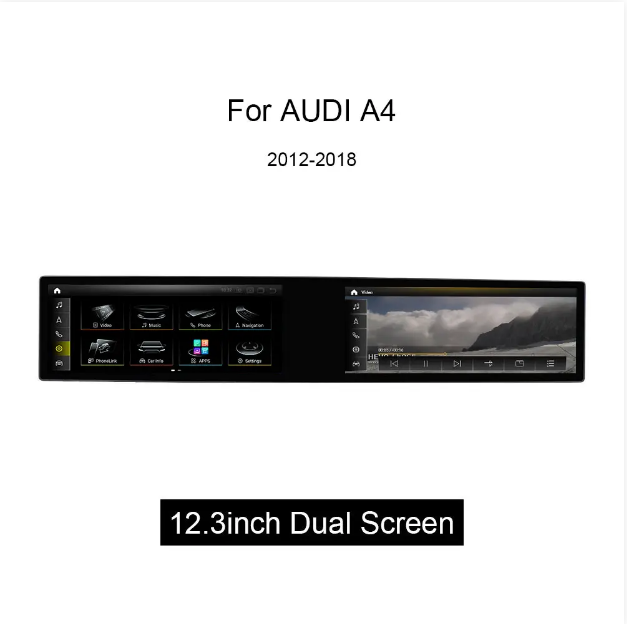
Ugode 12.3inch Android Dual Touchscreen Replacement Upgrade CarPlay Includes Co-Pilot Panel for AUDI A4
The A4 Paradox: A Great Car With a 2012 Brain
Ask any owner of a 2012–2018 Audi A4 what they would change, and the answer is almost always the same: the screen. The complication is that “2012–2018″ spans two quite different cars.
B8 / B8.5 (up to 2015). The facelifted B8.5 ran MMI 3G+ navigation — identifiable by a media version beginning with HN+_EU — driving a 6.5-inch non-touch display controlled by the rotary MMI dial. MMI 3G has no hardware path for smartphone mirroring at all, which is exactly why a whole cottage industry of external CarPlay interface modules exists for it.
B9 (2015 onwards). The B9 moved to MIB2 with a 7-inch or 8.3-inch screen and added the excellent Virtual Cockpit. But on most 2016–2018 cars, CarPlay and Android Auto were absent or wired-only, locked behind option packs or a dealer activation fee.
Then there is reliability. MMI faults are among the most reported issues on modern Audis, with owners documenting random reboots, black screens and — critically — loss of the reversing camera mid-manoeuvre when the system resets. Infotainment that can blank out while you reverse is a safety problem, not a nuisance.
So owners face three unsatisfying options: live with an 8-inch screen from 2016, pay dealer money for an activation that still leaves a small screen, or add a dongle that squashes CarPlay into a low-resolution panel never designed for it.
UGODE’s answer is different: replace the whole thing — and then add a second one.
Meet the Ugode Android Dual Touchscreen AUDI A4
The Ugode Android Dual Touchscreen AUDI A4 is not a dongle, not an overlay and not a clip-on tablet. It is a full replacement centre-stack assembly built around two 12.3-inch capacitive touch panels at 1920×720 — a driver display plus a dedicated co-pilot panel — running genuine Android 13 on a Qualcomm Snapdragon 665.
- Dual 12.3″ 16:9 LCD, capacitive touch — driver screen plus co-pilot screen
- Dual system: original Audi MMI and Android, switchable on the fly — drive select, car settings, service intervals and factory radio all retained
- Built-in CarPlay and Android Auto — no dongle, wireless or wired, plus mirroring and Phone Link
- Split-screen multitasking: two apps at once
- Full OEM retention: radio, GPS, Bluetooth, USB, SD, original or aftermarket reversing camera (selectable)
- Built-in 4G LTE (Europe/Asia) and dual-band WiFi — the car has its own data connection, independent of your phone
- Steering wheel and MMI knob control retained
- 14 languages, including English, German and Chinese
- AHD CCD reverse camera, with 360° panoramic view optional
Virtual Cockpit — the question every B9 owner asks. It keeps working. The Virtual Cockpit runs on its own processor and reads data straight from the CAN bus, independently of the head unit, so speed, fuel, trip computer and media all continue normally. The one nuance: turn-by-turn arrows sourced from the factory navigation may no longer reach the cluster — Google Maps or Waze simply runs on the new main screen instead.
Full Specification
|
# |
Item |
Specification |
|
1 |
CPU |
Qualcomm Snapdragon 665 (SM6125), Octa-core 11nm LPP — 4× A73 @ 2.0 GHz + 4× A53 @ 1.8 GHz |
|
2 |
GPU |
Adreno 610 @ 950 MHz |
|
3 |
Operating System |
Android 13 (real Android 13) |
|
4 |
Memory / Storage |
4+64 GB / 8+128 GB / 8+256 GB — eMCP (eMMC 5.1 / UFS 2.1 + LPDDR4X) |
|
5 |
Screen & Resolution |
Dual 12.3″ 16:9 IPS LCD, G+G capacitive touch, 1920×720 |
|
6 |
Bluetooth |
Bluetooth 5.0 + BR/EDR + BLE — A2DP, hands-free, phonebook, call history |
|
7 |
WiFi |
IEEE 802.11 — 2.4 GHz b/g/n + 5 GHz a/g/n/ac (dual band) |
|
8 |
4G SIM |
LTE Category 4 — 150 Mbps down / 75 Mbps up (Europe & Asia) |
|
9 |
Video |
4K HD playback; H.264 (AVC) and H.265 (HEVC); MP4 / AVI / MKV / MOV / WMV / DIVX |
|
10 |
Graphics |
OpenGL ES 3.1+, OpenCL 2.0 |
|
11 |
Smartphone Integration |
Wireless & wired Apple CarPlay; wireless & wired Android Auto; Phone Link; wireless and wired mirroring — built in, no dongle |
|
12 |
Camera |
AHD CCD reverse camera; original & aftermarket rear camera selectable |
|
13 |
GPS |
GPS / BeiDou / GLONASS; built-in and online maps (Google Maps, Waze) |
|
14 |
Expandable Memory |
Micro TF card slot + USB port |
|
15 |
Optional |
360° panoramic view camera |
|
16 |
Audio & Control |
Original functions retained; steering wheel + MMI rotary knob control; 14 languages |
|
17 |
Working Temperature |
−30 °C to +80 °C |
|
18 |
Fitment |
Audi A4, 2012–2018 (MMI version confirmed before order) |
Why Two Screens? The Co-Pilot Panel Is Not a Gimmick
This is what separates the Ugode Android Dual Touchscreen AUDI A4 from the dozens of single-screen Android head units on the market.
Passenger displays have quietly become one of the fastest-growing segments in automotive electronics: researchers forecast the automotive passenger display market growing at roughly 18.6% CAGR to around USD 5.8 billion by 2031, with the 11-to-14-inch band the largest size segment — precisely where this panel sits. Mercedes-Benz has rolled MBUX Superscreen across the S-Class, GLE and GLS; BMW has a 14.6-inch Passenger Screen on the 7 Series and X5. The premium segment has already decided the passenger deserves their own screen.
The use cases are practical:
- Navigation co-pilot. The passenger searches for the destination or parking and pushes it across. The driver keeps both hands on the wheel.
- Passenger entertainment. Video on the co-pilot panel while the driver’s screen holds navigation — the number-one reason families buy dual-screen cars.
- Split-screen productivity. Two apps, two screens, no menu-diving.
The counter-argument is fair: some OEMs report modest daily use of passenger screens, and regulators are focused on distraction and glare. The industry answer is privacy and dimming control — Porsche runs Privacy Mode on the Taycan passenger display, Visteon offers Active Privacy, BMW darkens the passenger screen when driver distraction is detected. For an aftermarket unit the guidance is the same: video on the co-pilot panel, navigation on the driver’s panel.
Market Context: Why This Category Is Booming
The retrofit market is scaling fast. The global automotive infotainment retrofit aftermarket is worth roughly USD 2.2 billion in 2025, projected to reach USD 6.1 billion by 2034 at about 10.8% CAGR; Android Auto retrofit kits alone are estimated at USD 2.1 billion in 2025.
CarPlay/Android Auto integration is the biggest revenue segment — about 42.5% of retrofit revenue, roughly USD 0.94 billion in 2025. Consumers already know these interfaces from their phones.
Full cockpit replacement is the fastest-growing sub-segment. “Embedded digital cockpit replacement” — exactly what this product is — holds about 26.3% share, growing at roughly 12.4% CAGR, with kit pricing typically USD 600–1,800. It is outgrowing the dongle tier because buyers want the whole experience.
Android is winning the aftermarket. Android Automotive’s aftermarket channel is growing at about 17.9% CAGR — faster than OEM. Head units command nearly 60% of aftermarket IVI revenue (USD 2.84 billion).
The fleet is ageing — that is the business case. Ownership duration for retrofit-target vehicles averages around 12.5 years. Every A4 built between 2012 and 2018 is now 8 to 14 years old: mechanically excellent, worth keeping, but carrying infotainment that predates wireless CarPlay entirely.
Demand is global. Asia-Pacific leads aftermarket IVI at about 35.3% (USD 1.69 billion), North America 25.6%, Europe 21.1%. And professional installation is roughly 64% of retrofit revenue, with labour typically USD 400–1,200 — a dual-screen job is a profitable half-day in the bay.
Who Is Actually Buying This?
1. The B8.5 owner with no smartphone integration. MMI 3G+ has no hardware path to CarPlay; this is the cleanest fix available.
2. The B9 owner with a 7-inch screen and a cable. Wireless CarPlay, a 12.3-inch panel and a co-pilot screen is a generational jump.
3. The family driver. Co-pilot screen = quieter journeys.
4. The business user. Built-in 4G LTE and Android 13 give the car its own connectivity without draining the phone.
5. The used-car dealer and exporter. A dual-screen cockpit photographs dramatically better and separates instantly from near-identical listings.
6. Export markets. Fourteen languages and a −30 °C to +80 °C range cover the Gulf to Scandinavia.
Installation: Two Things to Check First
The unit is a direct replacement with vehicle-specific harnesses — no wire cutting, no splicing, no dash modification — and the original MMI remains available at a touch.
- Confirm your MMI generation. On a B8/B8.5, press SETUP next to the MMI controller and check Version information; MMI 3G+ software begins with HN+_EU. On a B9, confirm whether you have the 7-inch MMI Radio Plus or 8.3-inch MMI Navigation Plus, and whether control is rotary or touch. Send a dashboard photo before ordering.
- Confirm your audio system. With Bang & Olufsen or the Audi Sound System, you need the correct amplifier interface adapter to retain it — bypassing a factory amp is the fastest way to make a premium car sound worse.
FAQ: Ugode Android Dual Touchscreen AUDI A4
Q1. Which Audi A4 models does it fit?
Audi A4, 2012–2018, covering B8.5 and early B9. Because this spans two MMI platforms, confirm screen size, MMI version and controller type before ordering.
Q2. Is it two separate 12.3-inch screens?
Yes — a main driver display plus a dedicated co-pilot panel, both 12.3-inch capacitive touch at 1920×720.
Q3. Do I lose the original Audi MMI system?
No. Factory MMI and Android 13 coexist and switch on demand. Radio, GPS, Bluetooth, USB, SD, vehicle settings and the original reversing camera are retained, along with steering wheel and MMI knob control.
Q4. Is CarPlay wireless?
Yes — wireless and wired Apple CarPlay and Android Auto, plus mirroring. It is built in; no external dongle required.
Q5. Will it work with my Virtual Cockpit?
Yes. The cluster runs independently and keeps displaying speed, fuel, trip and media data. Factory-sourced turn-by-turn arrows may no longer appear in it; navigation runs on the new main screen.
Q6. Does the co-pilot screen distract the driver?
The panel is angled toward the passenger, and the practice — consistent with OEM privacy modes — is to keep video on the passenger side and navigation on the driver’s side.
Q7. What about my Bang & Olufsen system?
Retainable with the correct amplifier interface adapter. Confirm at the point of order.
Q8. Does it need my phone’s data?
No. Built-in 4G LTE (Europe/Asia) and dual-band WiFi keep the car online independently.
Q9. Can I add cameras?
Yes. AHD CCD reverse camera is included, original and aftermarket rear cameras are selectable, and a 360° panoramic system is optional.
Q10. Is this better value than a CarPlay activation or a dongle?
If you only want to remove a cable, a dongle is cheaper. If you want a 12.3-inch screen, wireless CarPlay, a full Android 13 app environment, a passenger display, 4G and 360° camera support — while keeping every original Audi function — nothing in the dongle tier comes close.
The Bottom Line
Your A4′s engine, gearbox and chassis have years of life left. The screen does not have to be the thing that makes the car feel old.
The Ugode Android Dual Touchscreen AUDI A4 gives a 2012–2018 A4 what it was never going to get from the factory: a 12.3-inch wireless CarPlay cockpit, a genuine Android 13 app ecosystem, and a co-pilot screen that turns the passenger into a navigator — without giving up a single original Audi function.
Post time: Nov-04-2026