

A great sports sedan, trapped behind a decade-old interface
There is nothing wrong with the way a 2012–2017 Lexus GS drives. The chassis is still composed, the V6 is still smooth, and the cabin still feels like a car that cost far more than it does on the used market today. What has aged badly is the dashboard. The factory screen is small by 2026 standards, the navigation maps are frozen in time, the voice system barely understands you, and — most importantly — the car was built before Apple CarPlay and Android Auto existed as consumer expectations.
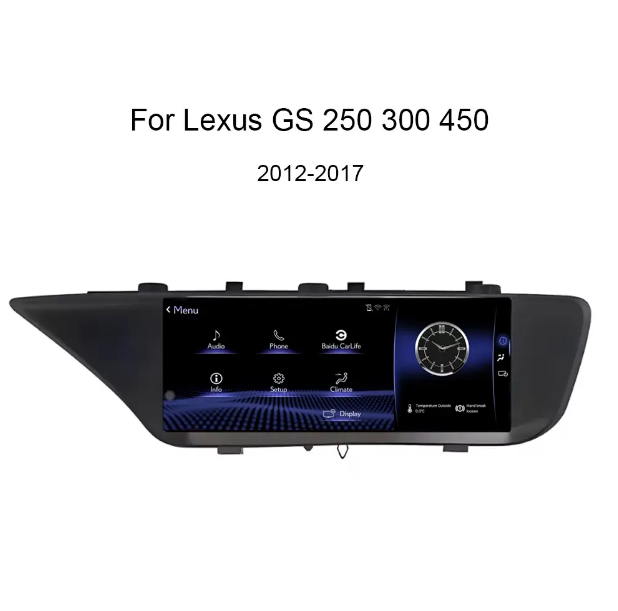
That gap between “mechanically excellent” and “digitally obsolete” is exactly where the aftermarket has stepped in. And the most complete answer for this generation of GS is the LEXUS GS 300 Android Screen from UGODE: a vehicle-specific 12.3-inch Android 13 multimedia system that replaces the stock display while keeping every original function your car left the factory with.
Why the 2012–2017 Lexus GS dashboard feels so dated
The fourth-generation GS (sold globally as GS 250, GS 300, GS 350 and GS 450h depending on market) arrived with a wide-format display and Lexus’ Remote Touch controller. Elegant in 2012, limiting in 2026:
- No smartphone projection. No Apple CarPlay, no Android Auto. Your phone — the device that actually holds your maps, music, podcasts and messages — has nowhere to go.
- Map data stuck in the past. Factory navigation relies on outdated map databases and rarely includes live traffic rerouting.
- No apps, no updates. Streaming services, offline maps, real-time weather and voice assistants simply aren’t available, and the head unit never receives an over-the-air refresh.
- Small, low-contrast display. Compared with today’s cabins, the original screen looks dim and cramped, especially when you’re trying to read a junction detail at a glance.
- Camera limitations. The factory reversing camera is low resolution and there is no path to a modern 360° panoramic view.
Meanwhile, the industry moved on without this car. Roughly 78% of 2025 model-year vehicles now offer wireless Apple CarPlay or Android Auto as standard or optional equipment, and survey work consistently puts smartphone integration at the top of buyers’ must-have lists — one widely cited J.D. Power figure puts it at 92% of car buyers, while Apple’s own buyer research suggests close to 80% of US new-car shoppers would not consider a vehicle without CarPlay support. Drivers aren’t being unreasonable; they just expect their car to behave like their phone.
Meet the UGODE LEXUS GS 300 Android Screen
UGODE builds this unit specifically for the Lexus GS 250 / 300 / 450 (2012–2017) dashboard. It isn’t a universal double-DIN box with a plastic bezel — it’s a moulded 12.3″ replacement panel designed to sit where the factory screen sat, driven by a dedicated CANBUS interface so the car and the new display speak the same language.
Ten things it changes on your daily drive
- 12.3″ IPS LCD touchscreen (1920×720). A G+G capacitive panel with wide viewing angles — the same class of screen size that now accounts for the majority of new-vehicle centre displays.
- Android 13 on Qualcomm Snapdragon 685. An octa-core 6nm platform (4×A73 @2.4GHz + 4×A53 @1.9GHz) with Adreno 610 graphics — fast map rendering, instant app switching, and 4K video decode.
- Wireless and wired Apple CarPlay / Android Auto. Plus Phone Link and wireless/wired phone mirroring. Get in, start the car, and your phone is on the screen — no cable.
- Genuine split-screen multitasking. Navigation on one half, music or video on the other. Genuinely useful on long motorway runs.
- Built-in GPS with GPS/BeiDou/GLONASS. Works with online maps or fully offline navigation apps — no signal dependency in rural areas or car parks.
- 4G LTE connectivity (LTE Cat 4). Insert a SIM and the head unit is online on its own: live traffic, streaming, real-time weather, updates. Dual-band 2.4G/5G Wi-Fi and Bluetooth 5.0 cover phone tethering and audio.
- Original audio quality preserved. The Mark Levinson system, the amplifier, the DSP tuning — all retained. You are upgrading the interface, not replacing the sound.
- Every factory feature kept. Original radio, on-board computer (oil, consumption, settings), the Remote Touch/joystick controller, steering wheel controls, parking sensors, parking trajectory and the factory reversing camera.
- Camera-ready. Keep the OEM camera, or add an AHD CCD reverse camera or an optional 360° panoramic view system.
- 18+ languages. English, Spanish, French, German, Arabic, Russian and more — relevant for export markets, fleet operators and resale.
Technical specification
|
# |
Item |
Specification |
|
1 |
CPU |
Qualcomm Snapdragon 685 (SM6225), Octa-core, 6nm LPP — 4×A73 (2.4GHz) + 4×A53 (1.9GHz) |
|
2 |
GPU |
Adreno 610 @ 1260MHz |
|
3 |
OS |
Android 13 |
|
4 |
RAM / ROM |
4+64GB / 8+128GB — eMCP (eMMC5.1 / UFS2.1 + LPDDR4X) |
|
5 |
Screen & resolution |
12.3″ IPS LCD G+G touch screen, 1920×720 |
|
6 |
Bluetooth |
Bluetooth 5.0 + BR/EDR + BLE, phonebook, Bluetooth music |
|
7 |
Wi-Fi |
IEEE 802.11 — 2.4G b/g/n, 5G a/g/n/ac |
|
8 |
4G SIM |
LTE Category 4 — up to 150Mbps down / 75Mbps up |
|
9 |
Video |
4K HD playback, H.264 (AVC), H.265 (HEVC) |
|
10 |
Image |
OpenGL ES 3.1+, OpenCL 2.0 |
|
11 |
CarPlay / Android Auto |
Wireless & wired Apple CarPlay; wireless & wired Android Auto; Phone Link; wireless and wired phone mirroring |
|
12 |
Camera |
AHD CCD reverse camera (optional 360° panoramic view camera) |
|
13 |
GPS |
GPS / BeiDou / GLONASS; supports built-in and online maps |
|
14 |
Extended memory |
Micro TF card slot + USB port |
|
15 |
Other features |
Real-time weather; split-screen; CANBUS; steering wheel control; car information; parking trajectory / radar |
|
16 |
Languages |
English, Spanish, French, German, Arabic, Russian, and more |
|
17 |
Fitment |
Lexus GS 250 / 300 / 450 — 2012, 2013, 2014, 2015, 2016, 2017 |
How owners actually use it: five real-world scenarios
The daily commute. Wireless CarPlay connects before you’ve released the handbrake. Waze flags the accident on your usual route and reroutes; the podcast you were listening to in the kitchen resumes on the car’s speakers, through the original amplifier. No cable, no pairing ritual.
The weekend road trip. Split screen does the heavy lifting: Google Maps or Sygic on the left, Spotify or YouTube Music on the right. With a 4G SIM installed, traffic data and weather are live, and passengers can stream on the head unit’s own connection rather than draining your phone’s data plan.
Parking an executive sedan. The GS is a long car in tight city spaces. The factory reversing display becomes a high-resolution AHD feed, and parking trajectory plus radar overlay stay active. Owners who frequently park on the street usually add the optional 360° panoramic camera — a bird’s-eye view is the single most-requested add-on in this segment.
Cold mornings and glovebox-free navigation. Because the GPS receiver supports GPS, BeiDou and GLONASS and works with offline maps, the unit navigates in tunnels, underground car parks and rural areas where a phone-only solution struggles.
Keeping the car’s character. This is the point most owners care about: the oil-life readout, fuel consumption history, climate menus, vehicle settings and steering wheel buttons all still work, and the Mark Levinson audio still sounds the way it did. You have not “converted” your Lexus into something generic — you have given it a modern interface.
Market context: why retrofit infotainment is booming
This isn’t a niche hobby market anymore. The global automotive infotainment retrofit aftermarket was valued at roughly $2.2 billion in 2025 and is projected to reach about$6.1 billion by 2034, a CAGR of around 10.8%. Within that, the Apple CarPlay / Android Auto integration segment alone accounts for approximately 42.5% of retrofit revenue (~$0.94 billion in 2025)**[20](@ref) — the single largest technology slice of the category. Separate tracking of Android Auto retrofit kits puts that sub-market at **$2.1 billion in 2025, growing to $4.4 billion by 2034.
Three structural forces are driving it:
1. Cars are getting older, not newer. The average in-use vehicle age in the United States passed 12.5 years in 2025, with the European fleet average near 12.1 years. Owners are holding on to well-built cars because new-car prices and financing costs pushed them to. Analysts estimate more than 58% of owners who have kept a vehicle beyond eight years would consider an infotainment upgrade within 24 months. A 2014 GS is squarely in that group.
2. The installed base is enormous. Estimates suggest over 800 million passenger vehicles on the road worldwide lack any factory smartphone integration, and hundreds of millions more have wired-only systems built before wireless projection was standard. That is why the aftermarket channel dominates retrofit sales with roughly 71% share.
3. Component costs collapsed while expectations rose. Capacitive panels in the 9–11″ range have fallen more than 45% in bill-of-materials cost since 2019, and automotive-class Qualcomm SoCs that were once reserved for OEM programmes are now available to aftermarket developers. That is precisely how a 12.3″ Snapdragon-powered Android 13 unit with wireless CarPlay became an attainable upgrade rather than a four-figure exotic — and why wireless, not wired, is now the baseline expectation, with wireless projection accounting for roughly a third of retrofit revenue and rising.
Add in the display trend — total centre information display area grew 19% year over year in 2025, with the 10–15″ class now representing 60% of passenger-vehicle sales — and it’s clear that a 12.3″ LEXUS GS 300 Android Screen isn’t an oversized gimmick. It’s the current industry norm, retrofitted into a car that predates it.
Installation, fitment and what to check before ordering
The unit is designed as a plug-and-play replacement: it comes with a vehicle-specific harness and CANBUS box, so there is no wire cutting and no permanent modification to the car. Most competent installers complete the job in a couple of hours; experienced DIY owners do it themselves with trim tools and patience.
Before ordering, confirm:
- Model year: 2012–2017 Lexus GS (GS 250 / GS 300 / GS 450 / GS 350, depending on market).
- Factory configuration: whether the car has the original 7″ or 12.3″ screen, and whether it is equipped with a factory 360° camera — the joystick-controller variants differ, so a dashboard photo is the fastest way to confirm.
- Left-hand or right-hand drive: bracket and bezel differ.
- Memory option: 4+64GB is smooth for navigation, CarPlay and music; 8+128GB is the better choice if you multitask heavily, install many apps, or plan to keep the car long-term.
A note on quality: independent reviews of retrofit head units consistently flag lag, Bluetooth drop-outs and clumsy menus as the main failure modes in this category. Those problems trace back to weak SoCs, poor CANBUS decoding and abandoned firmware. Choosing a Snapdragon 685 platform with genuine CANBUS integration — rather than a generic Android box — is the most reliable way to avoid them, and it’s also why professional installation is recommended even on plug-and-play kits.
FAQ
Will I lose my Mark Levinson sound system?
No. The unit is integrated into the vehicle’s existing audio path, so the factory amplifier, speakers and tuning are retained.
Do the steering wheel buttons and the Remote Touch controller still work?
Yes. CANBUS integration keeps steering wheel controls, the original controller and the factory vehicle menus fully functional.
Does the factory reversing camera still display?
Yes — and you can upgrade to an AHD CCD camera or add a 360° panoramic view system.
Is Android Auto and CarPlay wireless?
Both are supported wirelessly and wired, along with Phone Link and phone mirroring.
Do I need internet?
No. Built-in GPS (GPS/BeiDou/GLONASS) works with offline maps. 4G SIM or Wi-Fi tethering simply adds live traffic, streaming and real-time weather.
Post time: Oct-30-2026