

The Cayenne still drives like a Porsche. Its screen doesn’t.
Slide behind the wheel of a 2019 Cayenne and everything feels right: the seating position, the steering weight, the way the air suspension settles over a broken road. Then you look at the centre stack. A modest display, a closed ecosystem, wired-only smartphone mirroring, and a navigation database that stopped feeling current years ago.
Meanwhile, a mass-market family SUV half the price now greets its driver with a 15-inch cinema panel and a separate screen for the passenger.
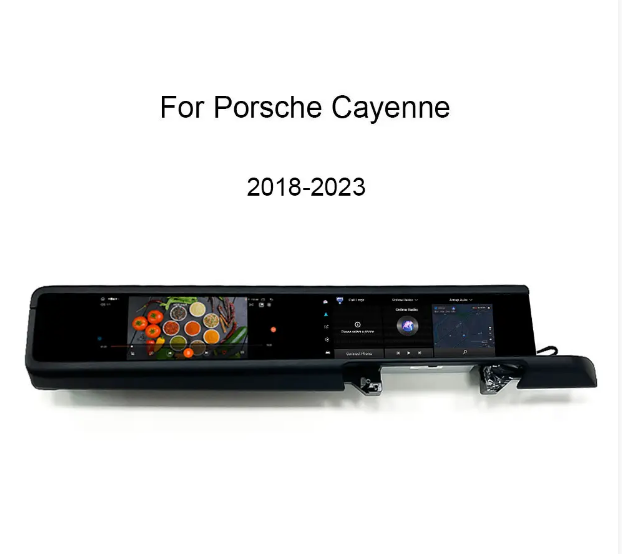
That gap — between how good the car still is and how dated the cabin feels — is exactly where the Porsche Cayenne dual Android screen retrofit from UGODE lives. It doesn’t replace your Porsche’s brain. It gives it a second one, plus a second screen for the person sitting next to you.
For owners of the third-generation Cayenne (9YA, 2018–2023, PCM 5.0, left- and right-hand drive), it is the single highest-impact interior upgrade available today — and unlike a coding activation, it changes what the hardware can actually do.
The market context: keeping the car, upgrading the cabin
This isn’t a niche hobbyist trend any more. It’s a structural shift in how people spend money on cars.
Vehicles are ageing, fast. S&P Global Mobility puts the average age of light vehicles on US roads at 12.8 years in 2025 — a record, with passenger cars at 14.5 years and light trucks at 11.9. Roughly 110 million vehicles, about 38% of the US fleet, now sit in the 6–14 year “aftermarket sweet spot”. Globally, the car parc is around 1.645 billion vehicles, and the total automotive aftermarket was estimated at US$860 billion in 2025.
Owners are choosing to upgrade rather than replace. With new-car transactions hovering near record highs and monthly payments climbing, the rational move for a perfectly healthy Cayenne is to invest a fraction of a new-car deposit into the cabin you touch every single day.
In-car connectivity has become non-negotiable. Edison Research’s 2025 US data found that 40% of vehicles now have smartphone integration (CarPlay or Android Auto) — and critically, 73% of owners who have it actively use it. AutoPacific’s July 2025 survey of nearly 18,000 intenders found more than 60% list wireless CarPlay or Android Auto as a must-have, up 12 points year over year, while McKinsey data suggests about a third of buyers would abandon a purchase over its absence. Even Tesla, which resisted CarPlay for a decade, has been reported to be testing it internally.
Screens have become the measure of “modern.” In China, the world’s most aggressive cockpit market, central screens are now effectively standard (95%+ fitment), 12-inch and larger panels account for 60% of installations, and screens of 11 inches or more make up over 69% of central display deliveries. New-energy vehicles average a 14.1-inch central screen versus 11.0 inches for combustion models.
And the passenger screen is going mainstream. Front passenger (“co-pilot”) displays reached roughly 9–10% penetration in 2025, with shipments jumping from 1.08 million to 1.69 million units — growth of about 56%. That’s the clearest signal yet that dual-screen cockpits are no longer a flagship gimmick. A Porsche Cayenne dual Android screen puts that same architecture into a car that was never designed for it.
Underlying all of it: Android has become the cockpit default. Android Automotive OS is expected to power close to 90% of mid- to high-end models launching in 2026, and Android Auto is already compatible with well over 250 million vehicles worldwide. Even OEMs are retrofitting — Porsche’s own PCCM Plus classic programme now brings wireless CarPlay and Android Auto to cars built decades ago.
What exactly is the UGODE Porsche Cayenne dual Android screen?
UGODE’s kit replaces the factory display assembly with two 12.3-inch IPS LCD capacitive touchscreens — one for the driver, one dedicated to the co-pilot — running independent Android 13 systems on a Spreadtrum UIS7870 octa-core processor (2× A76 + 6× A55) with a Mali-G57 GPU. Together they form a 24.6-inch continuous digital surface across the dash.
The engineering detail that matters most: this is an “add-on brain,” not a rip-out. Both the original Porsche system and the Android system coexist, switchable at will.
That means after installation you keep working:
- Original radio and Bluetooth telephony
- Factory rear-view camera and parking radar
- Steering wheel controls and the centre console knob / touchpad control
- Vehicle settings, climate and car information display
- Original Bose or Burmester sound systems (with the optional optic fibre decoder box)
Switch one way, you’re in a full Android cockpit with the entire Google Play ecosystem. Switch the other, your Porsche is exactly as it left the factory. Nothing is coded away, nothing is permanently lost.
Six reasons owners are doing this upgrade
1. Two screens, two people, zero arguments.
The driver screen runs navigation; the co-pilot screen runs something else entirely — a film, a playlist, a video call background, a route the passenger is researching. Each side operates independently, which is the whole point of a dual Android screen rather than a stretched single panel. Split-screen multitasking is also supported on each display.
2. No more CarPlay dongles.
Wireless and wired Apple CarPlay, plus wireless and wired Android Auto, are built in. Get in, and your phone connects — no dongle rattling in the centre console, no adapter to re-pair every iOS update.
3. Real navigation, with live data.
Built-in GPS/Beidou/Glonass with Google Maps, Waze and offline map apps, backed by 4G LTE (150 Mbps down / 75 Mbps up) and dual-band Wi-Fi. Traffic rerouting that factory PCM simply cannot match.
4. Sound that respects the badge.
A built-in DSP with 32-band EQ plus the optional fibre-optic box means Bose and Burmester systems stay intact and can be tuned properly — rather than being bypassed by a generic amplifier, which is where many cheap retrofits ruin a premium car.
5. Entertainment that actually plays anything.
4K-capable decoding across H.264/H.265, and broad container support (MKV, AVI, MP4, MOV, WMV, RMVB and more), with USB, Micro TF card and app installs. Music, podcasts, streaming, kids’ content — all native, all offline-capable.
6. Parking confidence, retained and improved.
The factory AHD CCD reverse camera and aftermarket cameras are both supported (selectable in settings), and an optional 360° panoramic view camera system can be added — useful on a vehicle this size.
How real owners actually use it
Talk to installers and a consistent picture emerges. The Porsche Cayenne dual Android screen isn’t bought as a spec-sheet trophy; it gets used in very specific, repeatable ways.
The weekday commute. Wireless CarPlay fires up before the seatbelt clicks. Waze handles live traffic, hands-free calling pulls from a synced phonebook with alphabetic search, and the driver never touches the phone. The co-pilot screen sits idle or shows trip info — until someone needs it.
The family road trip. This is the scenario that sells the second screen. The passenger streams a series or a cartoon, connected to Bluetooth headphones, while the driver keeps full-screen navigation and the kids stop asking “are we there yet.” In a traditional single-screen car, that means a phone propped on the dash or a tablet on a headrest strap.
The mobile office. Sales and founder-owners use the 4G SIM as a rolling hotspot, run calendar and messaging on the co-pilot panel during a stop, and keep the driver display on route guidance. In markets where the Cayenne doubles as a client shuttle, the passenger screen quietly does brand work.
The audio build. Enthusiasts who’ve already invested in Burmester keep the fibre loop alive via the optional decoder box, then use 32-band EQ and high-resolution files over USB/SD to finish the tuning that the factory system never allowed.
The urban park. Reversing cameras, radar and the optional 360° view turn a five-metre SUV into something manageable in underground garages — a daily pain point in European and Asian cities.
Export and right-hand-drive markets. With LHD and RHD variants and 15 interface languages, the same unit ships to Germany, the UK, Japan, Australia, the Middle East and beyond. That breadth is why distributors, not just DIY owners, stock this SKU.
Worth knowing: which Cayenne do you have?
Porsche’s PCM generations matter here. PCM 5.0 equips the third-generation Cayenne (9YA, including Coupé) from 2018 onward; the 2023 facelift moved to PCM 6.0 with larger, curved displays and native full-screen wireless CarPlay. Earlier cars on PCM 4.x are limited to wired, sometimes half-screen CarPlay — which is precisely why hardware retrofits exist.
UGODE’s dual screen targets Porsche Cayenne 2018–2023, PCM 5.0, LHD and RHD. Before ordering, confirm your software version in the PCM menu (SET → System → Software Update → Version Information); a version string beginning “MH2p” indicates PCM 5.0. Your installer can verify in seconds.
Technical specification
|
# |
Item |
Specification |
|
1 |
CPU |
Spreadtrum UIS7870, 8-core (2× A76 + 6× A55) |
|
2 |
GPU |
ARM Mali-G57, 850 MHz |
|
3 |
Operating system |
Android 13 |
|
4 |
Memory / Storage |
6+128 GB / 8+256 GB / 12+256 GB (LPDDR4 + eMMC) |
|
5 |
Screen & resolution |
Dual 12.3″ IPS LCD, G+G capacitive touch, 2400 × 900 |
|
6 |
Bluetooth |
V2.1 + EDR, v5.0 Low Energy (LE) |
|
7 |
Wi-Fi |
802.11 b/g/n, 5G Wi-Fi |
|
8 |
4G SIM |
LTE Cat 4 — 150 Mbps down / 75 Mbps up |
|
9 |
Video |
4K HD playback, H.264 (AVC), H.265 (HEVC) |
|
10 |
Graphics API |
OpenGL ES 3.1+, OpenCL 2.0 |
|
11 |
Smartphone integration |
Wireless & wired Apple CarPlay; wireless & wired Android Auto |
|
12 |
Camera |
AHD CCD reverse camera (OEM & aftermarket, selectable) |
|
13 |
GNSS |
GPS / Beidou / Glonass; offline and online maps |
|
14 |
Extended memory |
Micro TF card slot + USB port |
|
15 |
Audio |
Built-in DSP, 32-band EQ |
|
16 |
Optional |
360° panoramic view camera; optic fibre box for Bose / Burmester |
Also supported: dual-system switching (OEM ↔ Android), independent driver/passenger operation, split-screen multitasking, steering wheel and knob control, original car information display, 15-language UI, MP3/WMA/MP4/DIVX/JPEG playback, A2DP hands-free calling with phonebook transfer, call history, and full app installation.
What to look for in any retrofit — and why UGODE checks the boxes
The aftermarket infotainment category is crowded, and quality varies enormously. Three things separate a good kit from a regret:
- Genuine CAN-bus and protocol integration, so steering controls, climate, radar and vehicle data keep working. A generic Android tablet glued to the dash fails here.
- Premium audio preservation. If a kit can’t talk to your Bose or Burmester fibre-optic loop, you’ve downgraded the car you paid extra for.
- Thermal and electrical stability. A screen that lags or reboots in summer heat is worse than the factory unit it replaced.
UGODE builds to vehicle-specific fitment rather than universal brackets, retains original functions by design, and offers the options (fibre decoder, 360° camera, memory tiers) that let installers configure per market and per customer.
Frequently asked questions
Will I lose my original Porsche functions?
No. Original radio, Bluetooth, rear camera, radar, steering-wheel control, knob control and vehicle settings all remain, and you can switch back to the factory system at any time.
Do I still need a wireless CarPlay adapter?
No. Wireless and wired CarPlay and Android Auto are built into the unit.
Does it work with Bose and Burmester?
Yes — with the optional optic fibre box, both systems remain fully functional.
Can the two screens show different content at once?
Yes. The driver and co-pilot displays operate independently, and each also supports split-screen multitasking.
Is my car compatible?
Porsche Cayenne 2018–2023 with PCM 5.0, in both left-hand and right-hand drive. Verify the software version before ordering.
Is it a DIY job?
Professional installation is strongly recommended. Expect dashboard trim removal, connector-level wiring, and a camera-source setting that must be configured for your vehicle.
A Cayenne from this generation has a decade of good miles ahead of it. What ages is the interface — and that’s the part you can change in an afternoon.
The UGODE Porsche Cayenne dual Android screen delivers what owners actually ask for: a cockpit that feels current in 2026, and a passenger who stops complaining about it. It keeps your Porsche a Porsche, keeps your Bose or Burmester intact, and adds the big-screen, dual-zone, always-connected experience that new cars use to justify their price tags.
Ready to upgrade? See full product details, options and fitment here:
Ugode dual Android Screen Replacement Upgrade Retrofit include Co-pilot Panel for Porsche Cayenne
https://www.ugode.com/12-3inch-porsche-cayenne-2019-year-android-dual-screen-display-apple-carplay-with-co-pilot-screen-product/
UGODE supplies vehicle-specific Android screen upgrades for Porsche, BMW, Mercedes-Benz, Audi, Land Rover and more. Distributor and installer enquiries welcome.
Post time: Oct-20-2026